Other types of vehicle questions Motorcycle theory test
This topic has 17 practice questions. Here are 10 of them with the right answer and why.
You're riding behind a long vehicle as it approaches a mini-roundabout. What should you do if the vehicle is signalling left, but is positioned to the right?
- Sound your horn
- Overtake on the left
- Keep well backRight answer
- Flash your headlights
Long vehicles need more room than other vehicles to turn at junctions. The driver may take up a position that seems strange, but they have to do this to make sure their rear wheels do not mount the kerb as they turn. Do not overtake on the left – the driver will not expect you to be there and may not see you. Staying well back will also give you a better view ahead.
Why should you be careful when you're riding on roads where trams also operate?
- Trams cannot steer to avoid youRight answer
- Trams give off harmful exhaust fumes
- Trams are noisy and slow
- Trams can brake very quickly
Trams run on rails and cannot deviate from the tracks. Keep a lookout for trams, as they move very quietly and you may not notice them approaching. Be particularly careful of the rails – they can be very slippery, especially when they're wet.
You're about to overtake a slow-moving motorcyclist. Which sign would make you take special care?
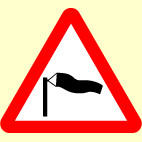 Right answer
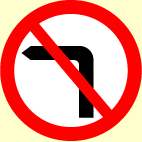
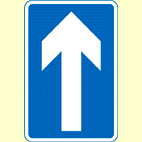
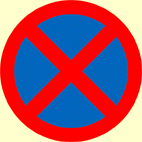
In windy weather, watch out for motorcyclists and also cyclists, as they can be blown sideways into your path. When you pass them, leave plenty of room and check their position in your mirror before pulling back in.
You're waiting to turn right out of a minor road. It's clear to the left but a lorry is coming from the right. Why should you wait, even if you have enough time to turn?
- Anything overtaking the lorry will be hidden from viewRight answer
- The lorry could suddenly speed up
- The lorry might be slowing down
- The load on the lorry might be unstable
Large vehicles can hide other vehicles that are overtaking – especially motorcycles. You need to be aware of the possibility of hidden vehicles and not assume that it's safe to turn.
You're following a long vehicle as it approaches a crossroads. What should you do if it signals left but moves out to the right?
- Get closer in order to pass it quickly
- Stay well back and give it roomRight answer
- Assume the signal is wrong and that it's turning right
- Overtake it as it starts to slow down
A long vehicle may need to swing out in the opposite direction as it approaches a turn, to allow the rear wheels to clear the kerb. Do not try to filter through if you see a gap; as the lorry turns, the gap will close.
You're following a long vehicle approaching a crossroads. What should you do if the driver signals right but moves close to the left-hand kerb?
- Warn the driver about the wrong signal
- Wait behind the long vehicleRight answer
- Report the driver to the police
- Overtake on the right-hand side
When a long vehicle is going to turn right, it may need to keep close to the left-hand kerb. This is to prevent the rear end of the trailer cutting the corner. You need to be aware of how long vehicles behave in such situations. Do not overtake the lorry, because it could turn as you’re alongside. Stay behind and wait for it to turn.
You’re approaching a mini-roundabout. What should you do if a long vehicle in front signals left but positions over to the right?
- Sound your horn
- Overtake on the left
- Follow the same course as the lorry
- Keep well backRight answer
At mini-roundabouts, there’s not much room for a long vehicle to manoeuvre. It will have to swing out wide so that it can complete the turn safely. Keep well back and do not try to move up alongside it.
You're travelling on a single carriageway road. Why should you keep well back while you're following a large vehicle?
- To give yourself acceleration space if you decide to overtake
- To get the best view of the road aheadRight answer
- To leave a gap in case the vehicle stops and rolls back
- To offer other drivers a safe gap if they want to overtake you
When following a large vehicle, keep well back. If you’re too close, you will not be able to see the road ahead and the driver of the long vehicle might not be able to see you in their mirrors.
You're travelling behind a bus. What should you do if it pulls up at a bus stop?
- Accelerate past the bus
- Look for pedestriansRight answer
- Sound your horn
- Pull in closely behind the bus
People may be running to catch the bus or passengers leaving the bus might wish to cross the road in front of the bus. Look out for them if you intend to go past it. Consider how many people are waiting to get on the bus – check the queue if you can. The bus might move off straight away if no-one is waiting to get on. If a bus is signalling to pull out, give it priority if it’s safe to do so.
You're following a lorry on a wet road. What should you do when spray makes it difficult to see the road ahead?
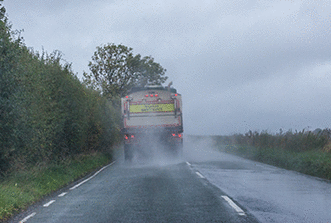
- Drop back until you can see betterRight answer
- Put your headlights on full beam
- Keep close to the lorry, away from the spray
- Speed up and overtake quickly
Large vehicles can throw up a lot of spray when it's wet. This makes it difficult for drivers behind to see the road ahead. You'll be able to see more by dropping back further, out of the spray. This will also increase your separation distance, giving you more room to stop if you have to.