Vehicle condition questions LGV theory test
This topic has 87 practice questions. Here are 10 of them with the right answer and why.
What's the main reason for cleaning your wheels and tyres when you leave a building site?
- To keep the tyres in good condition
- To prevent the tyres from damaging the road surface
- To reduce air leakage from the tyre valves
- To stop mud dropping onto the roadRight answer
If your wheels leave mud on the road, you must arrange for it to be cleared. A slippery, muddy surface could cause danger to other road users.
Your vehicle has double rear wheels. Why should you check them before leaving a building site?
- To make sure the diff-lock is engaged
- To make sure the diff-lock is disengaged
- To check that the load-sensing valve is operating correctly
- To make sure bricks or debris are not wedged between the wheelsRight answer
While driving on a building site, bricks, mud or other debris can become lodged between a lorry's double rear wheels. When you leave the site and increase your road speed, anything lodged between the tyres could be thrown out. This flying debris can be a hazard for drivers of following vehicles and can create dangerous road conditions, especially for motorcyclists.
What should you check before you drive off a muddy building site onto the road?
- The diff-lock is disengagedRight answer
- The diff-lock is engaged
- The steering lock is engaged
- The twist lock is disengaged
Attempting to drive at normal speeds with the diff-lock engaged is dangerous; it will severely affect your steering control. The diff-lock is designed to be used in slippery conditions, at low speed, when maximum traction is required.
You're driving a lorry along a motorway. You notice that you're losing tread from one of your tyres. What should you do?
- Stop on the hard shoulder and phone for assistanceRight answer
- Stop on the hard shoulder and change the wheel
- Continue driving to the next service station
- Continue driving and leave by the next exit
Continuous high speeds on the motorway can cause the tyres to become hot and to shred. If you notice this happening, you must stop on the hard shoulder as soon as it's safe to do so. It's dangerous to drive a defective vehicle.
What's the minimum depth of tread required over three-quarters of the breadth of a lorry tyre?
- 1 mmRight answer
- 1.5 mm
- 2.5 mm
- 5 mm
Tyres are your lorry's only contact with the road. It's essential that this contact gives you the grip you need to control your vehicle at all times. For that reason, goods vehicles must have a tread depth of at least 1 mm across three-quarters of the breadth of the tread and in a continuous band around the entire circumference.
What's the final thing you should do after recoupling a trailer?
- Connect the brake lines
- Release the trailer parking brakeRight answer
- Connect the electrical lines
- Raise the trailer legs
It's important to work methodically when uncoupling or recoupling a tractor unit and trailer. After recoupling, check that all connections, systems and lights are working correctly.
When should your lorry coupling system (fifth wheel) be checked and lubricated?
- Only prior to an MOT test
- Every 6 months
- Yearly
- RegularlyRight answer
Maintenance of the fifth wheel should be carried out regularly, ideally monthly or every 10,000 km.
You're driving a new articulated lorry that's fully laden. You notice that the steering feels heavy. What's the most likely reason?
- The road is icy
- The power steering is faultyRight answer
- The lorry is new
- The load on the trailer has shifted
Heavy steering could mean there's a fault with the power steering. It should be investigated as soon as possible. Many large vehicles can become undriveable if the power steering fails completely.
When should wheel nuts be checked?
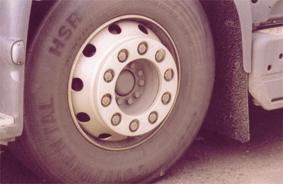
- After driving down a steep hill
- Soon after initial tighteningRight answer
- Just after driving on a motorway
- After unloading
Always have wheel nuts checked soon after their initial tightening. They should be tightened to the torque specified by the vehicle manufacturer.
What would you secure with a dog clip?
- The kingpin release handleRight answer
- The air lines
- The parking brake
- The diff-lock
When recoupling, you must connect the dog clip to secure the kingpin release handle.