Vehicle weights and dimensions questions LGV theory test
This topic has 75 practice questions. Here are 10 of them with the right answer and why.
What does this road sign mean?
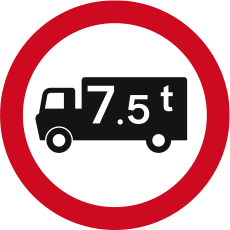
- No goods vehicles under 7.5 tonnes maximum authorised mass
- No goods vehicles over 7.5 tonnes maximum authorised massRight answer
- No goods vehicles over 7.5 metres overall height
- No goods vehicles under 7.5 metres overall height
It's essential that all limits are complied with to avoid breaking the law and facing possible prosecution. Weight restrictions normally apply to the plated weight of a vehicle, often referred to as the maximum authorised mass (MAM).
What does this temporary sign mean for drivers of vehicles over 7.5 tonnes maximum authorised mass?
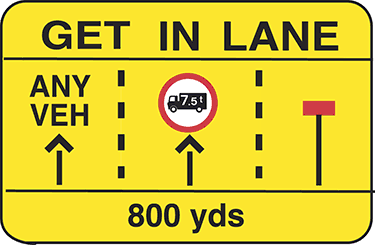
- Use either the left-hand or middle lane
- Use only the left-hand laneRight answer
- Use only the middle lane
- Use any lane
Lanes at roadworks often have weight restrictions to keep larger vehicles in the left-hand lane. The lanes through the roadworks are often narrow and therefore not wide enough for large vehicles to pass each other safely. Always look for restriction signs at roadworks. They're usually placed well in advance to give you time to move safely into the correct lane in good time.
In England and Wales, what's the national speed limit on a single carriageway road for a rigid lorry with a maximum authorised mass of more than 7.5 tonnes?
- 30 mph
- 40 mph
- 50 mphRight answer
- 60 mph
In England and Wales, vehicles exceeding 7.5 tonnes maximum authorised mass are restricted to a maximum of 50 mph on single carriageway roads. In Scotland, this speed limit is 40 mph.
You're driving a lorry with a maximum authorised mass of more than 7.5 tonnes along a three-lane motorway. When may you use the right-hand lane?
- To overtake slower lorries
- When the left-hand lane is closedRight answer
- If you drive at more than 60 mph
- If you're travelling unladen
Use of the right-hand lane on motorways with three or more lanes is not normally allowed for • vehicles over 7.5 tonnes maximum authorised mass • vehicles required to be fitted with a speed limiter • vehicles towing a trailer. This rule does not apply in special circumstances, such as when the left-hand lane is closed.
Where are you most likely to ground a low loader?
- On rural roads
- On traffic-calming humpsRight answer
- On yellow rumble strips
- On hatched road markings
Traffic-calming measures are becoming more common. Look out for signs warning you of humps in the road ahead. If necessary, change your route rather than take risks.
You're driving a low loader and you see this sign. What's your main concern at this hazard?
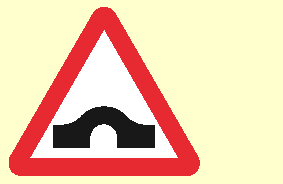
- The ground clearanceRight answer
- The weight limit
- The height limit
- The load's security
You have a responsibility to be aware of the dimensions of your vehicle, including ground clearance. When planning your route, you'll have to consider whether the roads you intend to use have any limits that would apply to your vehicle, such as • weight • length • height • ground clearance.
You're driving a vehicle that's over 17 metres (55 feet) long. What should you do at a level crossing?
- Cross over using your horn and hazard warning lights
- Stop before the crossing and phone the signal operatorRight answer
- Increase your speed to clear the crossing quickly
- Stop before the crossing and look both ways before going on
If your vehicle is over 17 metres (55 feet) long and you wish to cross a level crossing, you must stop before the crossing and telephone the signal operator.
What type of fastening or restraint should you use when carrying a load of steel?
- ChainsRight answer
- Straps
- Ropes
- Sheeting
You're responsible for the safety of the load you're carrying. At no time should the load endanger other road users. It's vital that you make sure your load is secure and safely distributed on your vehicle. How you do this will depend on the • bulk • weight • type of vehicle you're driving (flat bed, curtain side, etc) • nature of the load.
You're driving a lorry carrying a load that's 4.5 metres (14 feet 9 inches) wide. What's the maximum speed you're allowed to drive on a motorway?
- 10 mph
- 20 mph
- 30 mph
- 40 mphRight answer
The speed limits imposed on vehicles carrying abnormal loads can be frustrating for other drivers, but you must not be tempted to exceed them. Remember, the more weight you're carrying, the longer it will take you to stop safely.
What's the speed limit on a dual carriageway in England when you're carrying a load that's 4.5 metres (14 feet 9 inches) wide?
- 15 mph
- 25 mph
- 35 mphRight answer
- 45 mph
Vehicles carrying loads between 4.3 metres (14 feet 1 inch) and 5 metres (16 feet 6 inches) wide are subject to lower speed limits. The limit depends on the type of road. On a motorway it's 40 mph (64 km/h), on a dual carriageway it's 35 mph (56 km/h), and on all other roads it's 30 mph (48 km/h).