Alertness questions Car theory test
This topic has 26 practice questions. Here are 10 of them with the right answer and why.
What should you do before making a U-turn?
- Give an arm signal as well as using your indicators
- Check road markings to see that U-turns are permitted
- Look over your shoulder for a final checkRight answer
- Select a higher gear than normal
If you have to make a U-turn, slow down and make sure that the road is clear in both directions. Make sure that the road is wide enough for you to carry out the manoeuvre safely. Use your mirrors and look round to check it's safe before turning across the road.
What should you do as you approach this bridge?
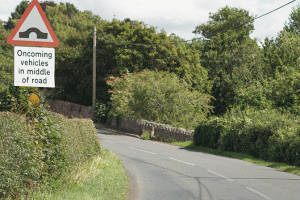
- Move to the right
- Slow downRight answer
- Change gear
- Keep to 30 mph
You should slow down and be cautious. Hump bridges are often narrow and there may not be enough room for you to pass an oncoming vehicle at this point. Also, there\'s no footpath, so be aware of pedestrians in the road.
Where should you avoid overtaking?
- Just after a bend
- In a one-way street
- On a dual carriageway
- Approaching a dip in the roadRight answer
Oncoming vehicles or other hazards can be hidden from view by dips in the road. If you cannot see into the dip, wait until you have a clear view and can see that it's safe before starting to overtake.
What does this curved arrow road marking mean?
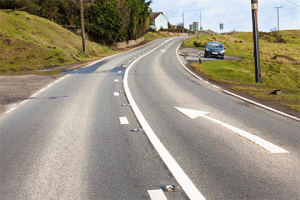
- Heavy vehicles should take the next road on the left to avoid a weight limit
- The road ahead bends to the left
- Overtaking traffic should move back to the leftRight answer
- The road ahead has a camber to the left
In this picture, the road marking shows that overtaking drivers or riders need to return to the left. These markings show the direction drivers must pass hatch markings or solid double white lines. They\'re also used to show the route that high vehicles should take under a low arched bridge.
What should you do if your mobile phone rings while you're driving or riding?
- Stop immediately
- Answer it immediately
- Leave it until you have stopped in a safe placeRight answer
- Pull up at the nearest kerb
It’s illegal to use a hand-held mobile or similar device when driving or riding, except in a genuine emergency. The safest option is to switch off your mobile phone before you set off, and use a message service. If you've forgotten to switch your phone off and it rings, you should leave it. When you've stopped in a safe place, you can see who called and return the call if necessary.
Why are these yellow lines painted across the road?
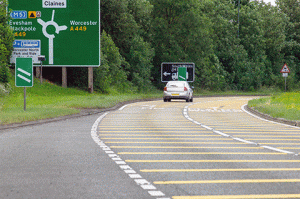
- To help you choose the correct lane
- To help you keep the correct separation distance
- To make you aware of your speedRight answer
- To tell you the distance to the roundabout
These lines are often found on the approach to a roundabout or a dangerous junction. They give you extra warning to adjust your speed. Look well ahead and do this in good time.
What should you do when you're approaching traffic lights that have been green for some time?
- Accelerate hard
- Maintain your speed
- Be ready to stopRight answer
- Brake hard
The longer traffic lights have been green, the sooner they'll change. Allow for this as you approach traffic lights that you know have been green for a while. They're likely to change soon, so you should be prepared to stop.
What should you do before slowing down or stopping your vehicle?
- Sound the horn
- Use the mirrorsRight answer
- Select a higher gear
- Flash the headlights
Before slowing down or stopping, check the mirrors to see what's happening behind you. Also assess what's ahead and make sure you give the correct signal if it will help other road users.
You're following a large vehicle. Why should you stay a safe distance behind it?
- You'll be able to corner more quickly
- You'll help the large vehicle to stop more easily
- You'll give the driver a chance to see you in their mirrorsRight answer
- You'll keep out of the wind better
If you're following a large vehicle but are so close to it that you cannot see its exterior mirrors, the driver will not be able to see you. Keeping well back will also allow you to see the road ahead by looking past the large vehicle.
Why should you use your mirrors when you see a hazard ahead?
- Because you'll need to accelerate out of danger
- To assess how your actions will affect the traffic behindRight answer
- Because you'll need to brake sharply and stop
- To check what's happening on the road ahead
You should be constantly scanning the road for clues about what's going to happen next. Check your mirrors regularly, particularly as soon as you spot a hazard. What's happening behind may affect how you respond to hazards ahead.