Vehicle handling questions Car theory test
This topic has 45 practice questions. Here are 10 of them with the right answer and why.
When may you overtake another vehicle on their left?
- When you’re in a one-way streetRight answer
- When approaching a motorway slip road where you’ll be turning off
- When the vehicle in front is signalling to turn left
- When a slower vehicle is travelling in the right-hand lane of a dual carriageway
You may pass slower vehicles on their left while travelling along a one-way street. Be aware of drivers who may need to change lanes and may not expect faster traffic passing on their left.
You're travelling in very heavy rain. How is this likely to affect your overall stopping distance?
- It will be doubledRight answer
- It will be halved
- It will be ten times greater
- It will be no different
The road will be very wet and spray from other vehicles will reduce your visibility. Tyre grip will also be reduced, increasing your stopping distance. You should at least double your separation distance to make sure you can stop safely in the space you've allowed.
What should you do when you're overtaking at night?
- Wait until a bend so that you can see oncoming headlights
- Sound your horn twice before moving out
- Go past slowly so that you can react to unseen hazards
- Beware of bends in the road aheadRight answer
Do not overtake if there’s a possibility of a road junction, bend or brow of a bridge or hill ahead. There are many hazards that are difficult to see in the dark. Only overtake if you’re certain that the road ahead is clear. Do not take a chance.
When may you wait in a box junction?
- When you're stationary in a queue of traffic
- When approaching a pelican crossing
- When approaching a zebra crossing
- When oncoming traffic prevents you turning rightRight answer
The purpose of a box junction is to keep the junction clear by preventing vehicles from stopping in the path of crossing traffic. You must not enter a box junction unless your exit is clear. However, you may enter the box and wait if you want to turn right and are only prevented from doing so by oncoming traffic.
Which plate may appear with this road sign?
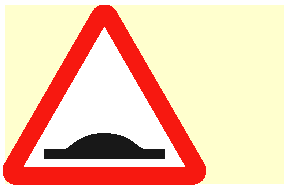
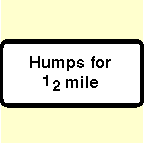 Right answer
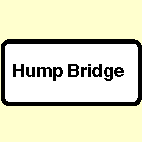
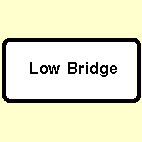

Road humps are used to slow down traffic. They\'re found in places where there are often pedestrians, such as • shopping areas • near schools • residential areas. Watch out for people close to the kerb or crossing the road.
What's the reason for traffic-calming measures?
- To stop road rage
- To make overtaking easier
- To slow traffic downRight answer
- To make parking easier
Traffic-calming measures make the roads safer for vulnerable road users, such as cyclists, pedestrians and children. These can be designed as chicanes, road humps or other obstacles that encourage drivers and riders to slow down.
What colour are the reflective studs along the left-hand edge of the motorway?
- Green
- Amber
- RedRight answer
- White
Reflective studs are used to help you in poor visibility. Different colours are used so that you’ll know which lane you're in. These are • red on the left-hand edge of the carriageway • white between lanes • amber on the right-hand edge of the carriageway • green between the carriageway and slip roads.
What\'s a rumble device designed to do?
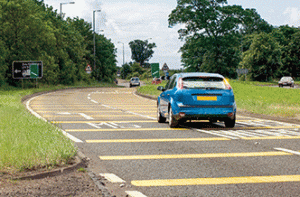
- Give directions
- Prevent cattle escaping
- Alert you to low tyre pressure
- Alert you to a hazardRight answer
A rumble device consists of raised markings or strips, designed to give drivers an audible, visual and tactile warning. These devices are used in various locations, including in the line separating the hard shoulder and the left-hand lane on the motorway and on the approach to some hazards, to alert drivers to the need to slow down.
What should you do if you have to make a journey in foggy conditions?
- Follow other vehicles’ tail lights closely
- Avoid using dipped headlights
- Leave plenty of time for your journeyRight answer
- Keep two seconds behind the vehicle ahead
If you’re planning to make a journey when it’s foggy, listen to the weather reports. If visibility is very poor, avoid making unnecessary journeys. If you do travel, leave plenty of time – and if someone is waiting for you to arrive, let them know that your journey will take longer than normal. This will also take off any pressure you may feel to rush.
What must you do when you're overtaking a car at night?
- Flash your headlights before overtaking
- Select a higher gear
- Switch your headlights to main beam before overtaking
- Make sure you do not dazzle other road usersRight answer
To prevent your headlights from dazzling the driver of the car in front, wait until you’ve passed them before switching to main beam.