Hazard awareness questions Car theory test
This topic has 78 practice questions. Here are 10 of them with the right answer and why.
Where would you expect to see these markers?
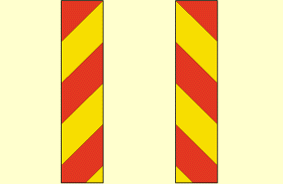
- On a motorway sign
- On a railway bridge
- On a heavy goods vehicleRight answer
- On a diversion sign
These markers must be fitted to vehicles over 13 metres long, heavy goods vehicles, and rubbish skips placed in the road. They\'re reflective to make them easier to see in the dark.
What\'s the main hazard shown in this picture?
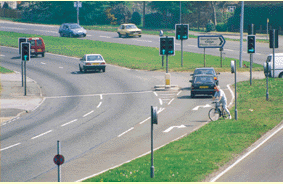
- Vehicles turning right
- Vehicles doing U-turns
- The cyclist crossing the roadRight answer
- Parked cars around the corner
Look at the picture carefully and try to imagine you\'re there. The cyclist in this picture appears to be trying to cross the road. You must be able to deal with the unexpected, especially when you\'re approaching a hazardous junction. Look well ahead to give yourself time to deal with any hazards.
Which road user has caused a hazard?
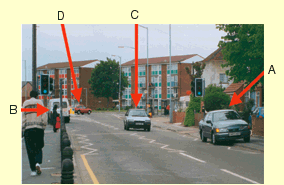
- The parked car (arrowed A)Right answer
- The pedestrian waiting to cross (arrowed B)
- The moving car (arrowed C)
- The car turning (arrowed D)
The car arrowed A is parked within the area marked by zigzag lines at the pedestrian crossing. Parking here is illegal. It also • blocks the view for pedestrians wishing to cross the road • restricts the view of the crossing for approaching traffic.
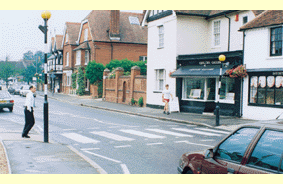
What should the driver of the car approaching the crossing do?
- Continue at the same speed
- Sound the horn
- Drive through quickly
- Slow down and get ready to stopRight answer
Look well ahead to see whether any hazards are developing. This will give you more time to deal with them in the correct way. The man in the picture is clearly intending to cross the road. You should be travelling at a speed that allows you to check your mirror, slow down and stop in good time. You should not have to brake harshly.
What should the driver of the grey car be especially aware of?
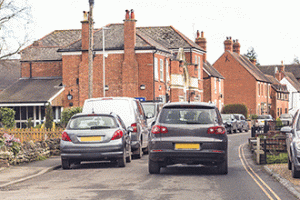
- The uneven road surface
- Traffic following behind
- Doors opening on parked carsRight answer
- Empty parking spaces
When passing parked cars, there\'s a risk that a driver or passenger may not check before opening the door into the road. A defensive driver will drive slowly and be looking for people who may be about to get out of their car.
What should you expect if you see this sign ahead?
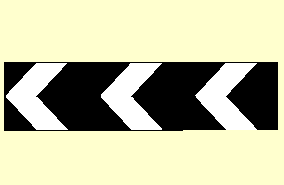
- The road will go steeply uphill
- The road will go steeply downhill
- The road will bend sharply to the leftRight answer
- The road will bend sharply to the right
This sign indicates that the road will bend sharply to the left. Slow down in plenty of time and select the correct gear before you start to turn. Braking hard and late, while also sharply changing direction, is likely to cause a skid.
What should you do as you approach this cyclist?
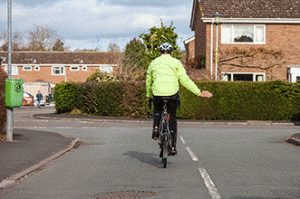
- Try to overtake before the cyclist gets to the junction
- Flash your headlights at the cyclist
- Slow down and allow the cyclist to turnRight answer
- Rev your engine so the cyclist knows you're following behind
Keep well back and give the cyclist time and room to turn safely. Do not intimidate them by getting too close or trying to squeeze past.
Why must you take great care when emerging from this junction?
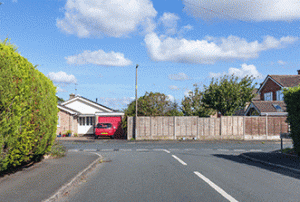
- The road surface is poor
- The footpath is narrow
- The kerbs are high
- The view is restrictedRight answer
You may have to pull forward slowly until you can see up and down the road. Be aware that the traffic approaching the junction cannot see you either. If you do not know that it’s clear, do not go.
Which type of vehicle should you be ready to give way to as you approach this bridge?
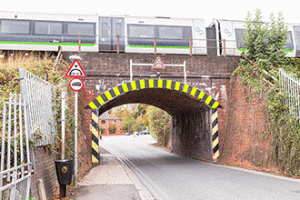
- Bicycles
- BusesRight answer
- Motorcycles
- Cars
A bus or high-sided lorry will have to take a position in the centre of the road to clear the bridge. There\'s normally a sign to show this. Look well ahead, past the bridge and be ready to stop and give way to large oncoming vehicles.
What type of vehicle could you expect to meet in the middle of the road?
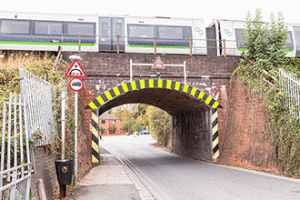
- LorryRight answer
- Bicycle
- Car
- Motorcycle
The highest point of the bridge is in the centre, so a large vehicle might have to move to the centre of the road to have enough room to pass safely under the bridge.